Living Room Decor Ideas to Elevate Your Space
Start by listing how you actually use the room in order of importance—movie nights, reading, hosting friends, play space for kids, or all of the above. Pick one top priority to shape every decision. If movies win, plan seating that faces the screen and keeps sight lines clear. If conversation matters more, make a U- or L-shaped setup around a coffee table. Defining a single goal keeps you from buying pieces that fight each other.
Choose a focal point—TV, fireplace, or a great window—and aim the main seat toward it. Keep 16–18 inches between the sofa and coffee table so you can reach snacks without bumping your knees. Leave 30–36 inches for walkways so people can pass without squeezing behind seats. Size the coffee table to about two-thirds the sofa length, and aim for a table height within an inch or two of your sofa’s seat height so it feels natural to use. If you’re short on space, consider a lift-top coffee table like the West Elm Industrial Storage Pop-Up or IKEA’s VITTSJÖ nesting tables to flex between work and lounging.
Layer your lighting because one overhead light makes a room look flat and strains your eyes. Use a dimmable floor lamp for overall glow (the Brightech Sky LED torchiere dimmer is affordable and bright), add two table lamps at opposite sides of the room to even out shadows (Target’s Project 62 line has sturdy, budget-friendly options), and include a focused reading light such as an Anglepoise Type 75 or IKEA RANARP next to your favorite chair. For TV watching, add LED bias lighting behind the screen—something like the MediaLight Mk2 or Govee kit reduces eye strain and improves perceived contrast.
Set a tight color palette so the room feels calm and cohesive instead of busy. Pick two to three neutrals (for example, warm white walls, camel upholstery, and charcoal accents) and one or two accent colors you actually wear or love (olive and rust, or navy and mustard). Use the accents in smaller items—pillows, throws, art—so you can swap them seasonally without replacing big pieces. A rug pulls the whole scheme together and defines the seating area: in most living rooms, an 8×10 or 9×12 works best, with front legs of sofas and chairs on the rug so the arrangement feels grounded. If spills are a worry, look at Ruggable or washable wool blends.
Choose materials that fit real life. Performance fabrics like Crypton, Revolution, or performance velvet resist stains, so sofas and ottomans stay cleaner longer. Add hidden storage to cut visual clutter—an Article Soma storage ottoman for blankets, a lift-top table for remotes and laptops, or a low IKEA BESTÅ media unit with doors to hide cables and game consoles. Washable cushion covers and machine-washable throws make cleanup easy. Finish with a few soft elements—curtains hung high and wide, a couple of plants, and textured pillows—to absorb echo and make the room feel comfortable without crowding it.
Once you’ve mapped the layout and palette, you can turn the plan into smart purchases: start with the right-size rug, anchor seating that supports your main goal, then add layered lighting and storage pieces that solve daily problems. The result looks good because it works well.
Define Your Living Room’s Function and Vibe

Define Your Living Room’s Function and Vibe
Start with how you’ll actually use the room most days. List what you do in there—reading, gaming, napping, hosting, movie nights, homework—and rank them.
That ranking matters because it decides your layout, lighting, and what you spend money on. If movie nights come first, you’ll want a larger TV, blackout curtains, and a deep sofa.
If reading and conversation win, you’ll prioritize layered lamps, side tables within reach, and quieter acoustics. Pick one main purpose and treat it as the boss; everything else fits around it.
Function
Think about sound, storage, and comfort because they’re what make a room easy to live in.
– Noise and acoustics: Soft surfaces absorb echoes, which makes voices clearer and movies less harsh. Add a thick rug (8×10 or larger in most living rooms) and lined curtains. Look at rugs like Ruggable’s Cushioned Collection or a wool rug from West Elm; both calm sound and feel good underfoot.
If you have hard floors and tall ceilings, add fabric lampshades, upholstered chairs, or even simple acoustic panels like Artnovion or affordable felt panels from Amazon placed behind the sofa.
– Atmosphere: Decide if this room should sound alive or stay calm. If you love music while you cook or read, a compact speaker like the Sonos One or the Apple HomePod mini gives clear sound without clutter.
If you prefer quiet, invest in blackout/thermal curtains (e.g., Eclipse or Pottery Barn Emery) to muffle street noise and control light.
– Storage that matches habits: Store things where you use them so they actually get put away. If you game, choose a media console with cord management (IKEA Besta or West Elm Mid-Century Media Console) and a drawer for controllers.
For blankets and remotes, use a lidded storage ottoman (Article’s Tessu or IKEA Vallentuna module) or a coffee table with drawers like the Pottery Barn Tanner.
Board games fit well in cube shelving (IKEA Kallax with baskets), and a slim tray on the arm of the sofa keeps remotes corralled. Add a small basket near the outlet where you charge devices, so cables don’t sprawl.
Lighting is part of function, too. Plan three layers: a dimmable floor lamp for overall light (the Brighttech Sky LED is a good budget option), table lamps for tasks (Target Project 62 has sturdy, affordable choices), and a reading light with a focused head (the IKEA Ranarp clamp or a pharmacy floor lamp).
Dimmers matter because they shift the room from “workable” to “cozy” without changing fixtures.
Vibe
Pick a look that supports how you want the room to feel, then back it up with colors and references.
– Choose a style by how you live, not by trends. Modern with clean lines is easy to keep tidy.
Mid-century works if you like warm woods and structured sofas. Boho suits layered textiles and plants. Farmhouse leans rustic and relaxed. If you like a mix, pair classic shapes with simple hardware and call it “classic meets modern.”
- Build a color palette you can actually shop: two to three neutrals and one to two accents. Example palettes:
- Warm calm: oatmeal, warm white, walnut wood, with rust and olive accents.
- Airy modern: soft gray, crisp white, light oak, with denim blue and charcoal.
- Moody cozy: deep green, cream, black, with brass and terracotta.
Use the neutrals for big pieces (sofa, rug, walls) and the accents for pillows, art, and a chair. This keeps the room flexible and prevents one bold choice from bossing everything around.
– Gather references so decisions stay consistent. Create a mood board with 8–12 images—rooms, sofas, rugs, lamps.
Tools like Pinterest or Milanote make it easy. Add product links you’d actually buy: a sofa model, a 9×12 rug you can afford, a lamp in stock. When all the images look good together, you’ve found your lane.
If something sticks out, adjust before you spend.
Commit
Write one clear sentence that sums up purpose and feel. This keeps you from buying “almost right” items.
- Example: “A quiet, reading-first living room with soft light, warm neutrals, and hidden storage, where two people can lounge with a book and a playlist.”
- Another: “A movie-and-game hub with blackout curtains, a deep sectional, and closed storage that hides cables and controllers.”
Use this sentence to test every purchase:
- Does this lamp help reading at night?
- Does this coffee table store the remotes and not wobble?
- Does this fabric fit the palette and stand up to our dog?
If it’s a yes, it stays on the list. If not, keep looking. This simple filter saves money, reduces returns, and gives you a room that works the way you actually live.
Plan the Layout Around How You’ll Use the Space
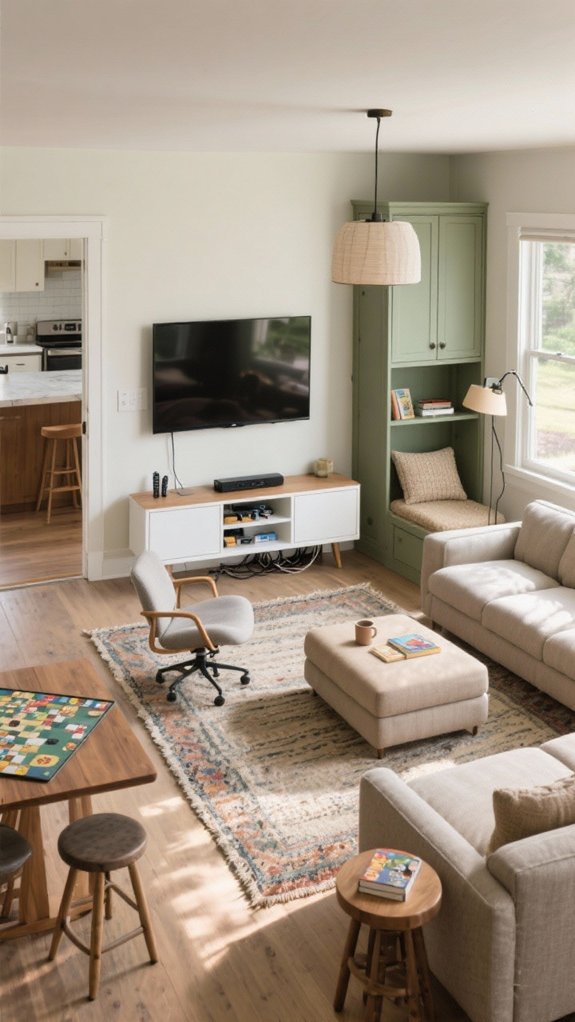
Start by turning the room into a simple floor plan. Measure wall to wall and sketch the outline. Mark every door swing, window, radiator, outlet, and vent. These details matter because they control where furniture can actually live and where cords and airflow need to go. Note where sound carries—hard surfaces and open doorways bounce noise to bedrooms, while soft items absorb it—so you can place speakers and a TV away from echo-prone corners. If you have pets or kids, map their usual paths. A cat sprinting from window to window or a dog looping from the hallway to the sofa tells you where not to place a delicate lamp or a top-heavy plant.
Set your anchors first. Decide on the focal point—TV, fireplace, or a view—and aim the main sofa at it. Leave about 18 inches between the sofa and the coffee table so you can set down a drink without leaning too far, but still move your legs comfortably. If you use a recliner, add a few extra inches behind it for the footrest and back movement. For a typical 84-inch sofa, a 48–54-inch coffee table works well; match the table height to within 2 inches of the sofa seat height for easy reach. If you’re mounting a TV, place the center of the screen around eye level when seated (usually 42–48 inches to the center) to prevent neck strain. Wall mounts like the Sanus VMPL50A let you pull the screen forward and angle it to reduce glare from windows.
Carve out zones so the room can do multiple jobs without feeling crowded. Use rugs to define each area: an 8×10 rug usually suits a standard living room, with front legs of sofas and chairs on the rug to tie the group together. For a reading nook, try a 5×8 under a lounge chair and small side table. A slim console table (10–14 inches deep) behind the sofa can act as a soft divider between a conversation area and a media zone; the IKEA Bestå or the West Elm Mid-Century Console are sturdy options that also hide cables. Add task lighting specific to each zone—an arc floor lamp like the Brightech Sky Dome for seating, a swing-arm lamp for reading, and bias lighting strips behind a TV to reduce eye fatigue.
Protect the flow so people aren’t dodging furniture. Leave 36–48 inches for main walkways—routes to doors, hallways, or the kitchen—so two people can pass without bumping shoulders. Secondary paths can shrink to about 24 inches if they’re used less often. Think about real-life movement: you need roughly 36 inches behind dining chairs to pull them out, and at least 12–18 inches beside a bed for easy making and nighttime access. Watch door swings; if a door knocks a chair, the chair is in the wrong spot. Place power where you need it—behind the sofa for charging, near the media wall for components—and plan cable routes now with low-profile surge protectors (Tripp Lite Protect It! series) and adhesive cord channels to avoid trip hazards.
Test the layout before you commit. Use painter’s tape or cardboard cutouts to mark the footprint of each piece. Sit on the sofa, set a drink on the taped coffee table outline, pivot toward the TV, and walk the main path. If you clip a corner or twist awkwardly, adjust. AR apps like IKEA Place or MagicPlan can help you preview scale, but your body will tell you more: can you reach the lamp switch without stretching? Does the swivel chair actually clear the rug edge? If you have pets, do a “tail test”—stand where a wagging tail would be and make sure it won’t sweep a glass off a side table; consider weighted coasters or a tray with a raised edge like the CB2 Chill Lacquer Tray on softer ottomans.
Make small upgrades that support how you live. Add a basket under the console for blankets if you watch movies often. Use a nesting side table set (like the Article Mara) to pull in when guests arrive and tuck away afterward. Place felt pads under heavy pieces so tweaking the layout is easy, and add a floor outlet cover if a cord must cross a walkway. When everything feels natural—conversation without shouting, TV without glare, and traffic without detours—you’ve got the layout right.
Choose a Cohesive Style That Fits Your Lifestyle
Choose a Cohesive Style That Fits Your Lifestyle
Before you buy another pillow, decide how you want your home to feel day to day. Start with function—how you actually use the space—then pick one clear lane (modern, boho, farmhouse, mid-century, or classic-meets-contemporary).
A set direction keeps every purchase working together, so you don’t waste money on pieces that fight each other. If you have kids or pets, that might mean performance fabrics and rounded corners. If you love hosting, you may want flexible seating and durable surfaces you don’t have to fuss over.
1) Set a few simple rules (so choices get easier, not harder)
Why it matters: Small, consistent guidelines make shopping faster and prevent impulse buys that don’t fit. You’ll get a pulled‑together look without hiring a designer.
- Pick 3 style traits and stick to them. Examples:
- Modern family-friendly: clean lines, low contrast, performance fabric
- Boho cozy: layered textiles, natural fibers, earthy colors
- Farmhouse fresh: shaker profiles, light oak, soft neutrals
- Mid-century warm: walnut wood, tapered legs, graphic shapes
- Classic-meets-contemporary: tailored silhouettes, crisp trim, matte black accents
- Choose 1–2 wood tones and 1 metal finish for the whole space. Limiting finishes makes the room feel intentional.
- Wood combos that play well: white oak + walnut; or all light oak
- Metals that are easy to repeat: matte black, satin brass, or brushed nickel
- Tip: Match your metal choice across cabinet hardware, lighting, and table legs for a cohesive thread.
Quick example: For a mid-century living room, you might choose “walnut + matte black,” then buy a walnut coffee table, a sofa with black metal legs, and black picture frames. Every new item has to fit those rules.
2) Plan for maintenance (so your space looks good on a Tuesday, not just in photos)
Why it matters: Materials determine how much time you spend cleaning or worrying. Durable, washable choices let you relax and actually use the room.
- Favor washable, hard-wearing textiles:
- Sofa fabrics: performance polyester, Crypton, or Sunbrella (try Article, Room & Board, or West Elm’s performance lines)
- Removable covers: IKEA SÖDERHAMN or UPPLAND, Bemz slipcovers for upgrades
- Rugs: low-pile wool, flatweave, or washable options like Ruggable; look at Loloi for tight-weave area rugs that don’t trap crumbs
- Choose tight weaves over shag or heavy boucle if you have shedding pets—fur vacuums off faster.
- Pick durable finishes for tables: sealed solid wood, high-pressure laminate, or ceramic/stone tops. West Elm, Article, and CB2 have sealed wood and ceramic-topped tables that resist rings.
- Skip fussy trim if you hate dusting: less fringe, heavy tufting, or carved crevices means less buildup and quicker wipe-downs.
- Add practical extras: a lidded storage ottoman for toys/throws, and performance throws you can machine-wash (Target Threshold, H&M Home).
3) Make a smart budget (spend where it shows and lasts)
Why it matters: A great sofa and rug set the tone for the whole room and take the most wear, so they deserve the biggest slice. Lighting and tables shape the mood and function. Accents are easy to swap as your taste evolves.
- A simple split that works:
- 60%: sofa + rug (comfort and proportion live here)
- 25%: lighting + tables (function and finish consistency)
- 15%: accents (pillows, art, throws, trays)
- Buy the best basics once, then layer accents over time.
- Sofa ideas: Article Sven (performance velvet or leather), Room & Board Metro (kid‑and pet‑friendly fabrics), IKEA SÖDERHAMN with upgraded Bemz cover
- Rug ideas: neutral flatweave wool (Loloi), jute/wool blend for boho, Ruggable for washability under dining tables or play zones
- Lighting: one strong ceiling fixture and 2–3 lamps for layers (Schoolhouse, Rejuvenation, CB2). Repeat your chosen metal.
- Tables: look for sealed wood or ceramic tops; nesting side tables add flexibility for guests (Article Mara, West Elm Tiered tables)
Bringing it together: Pick your lane and write your rules on your phone—for example, “Modern cozy: clean lines, warm neutrals, matte black; white oak + black; performance fabric.” Use that checklist when you shop.
If a piece doesn’t match at least two of the rules, skip it. Over a few purchases, your room will feel cohesive, comfortable, and easy to keep up—because it’s built for your real life.
Build a Visual Mood Board for Clarity
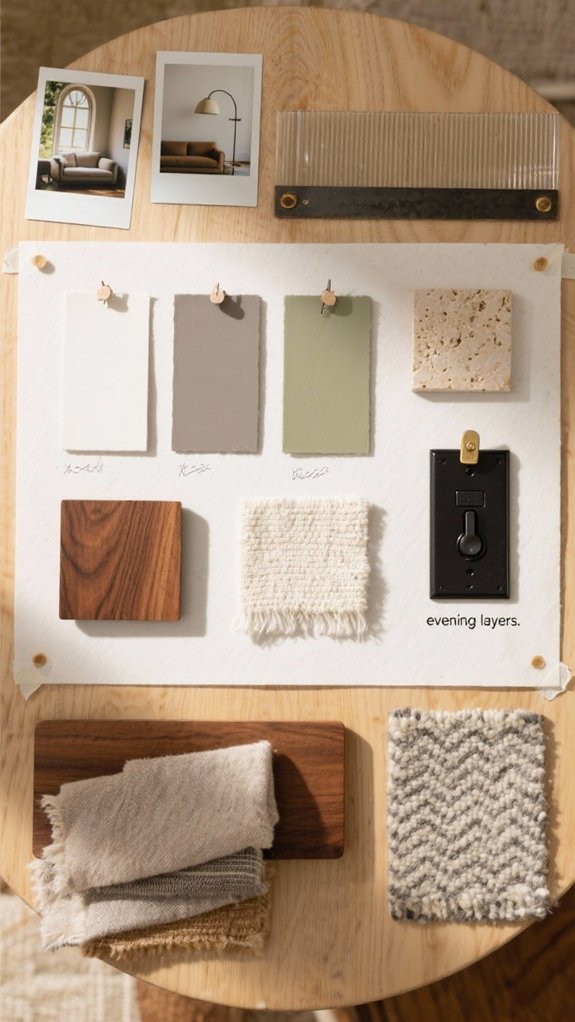
Build a visual mood board to turn your ideas into something you can see and react to. It helps you commit to a direction, spot what doesn’t fit, and shop without second‑guessing. When you can compare pieces side by side—scale, color, texture—it’s much easier to say yes or no quickly.
Start by gathering the right inputs
- Collect images of rooms, furniture, finishes, and layouts that feel close to what you want. Screenshot from design sites, Instagram, and retailers (e.g., Room & Board sofas, West Elm lighting, CB2 accent chairs).
- Photograph what you already own in good light (sofa, rug, art) and note rough measurements. This keeps your board grounded in reality and prevents buying items that clash in scale or color.
- Jot down the source of each image. Credit matters if you share your board, and some creators restrict reuse.
- If you plan to publish it, check usage notes or look for royalty‑free images on Unsplash or Pexels.
Pick tools that make arranging fast
- Pinterest is great for quick collecting; use sections to sort by room or element.
- Canva or Milanote let you drag items onto one canvas, add labels, and export as a single image. Canva has free interior mood board templates; Milanote keeps notes and links attached to each image.
- If you prefer simple and offline, try Apple Freeform (iPad/Mac), PureRef (lightweight desktop canvas), or Google Slides.
- Helpful add‑ons: the Pinterest Save button, the GoFullPage screenshot extension, and color tools like Adobe Color or Coolors to capture a palette from an image. Pantone Connect is useful if you’re coordinating with paint or textiles.
Assemble, then refine with intent
- Place your anchor pieces first—existing sofa, rug, or a must‑have light fixture—then build around them.
- This prevents a board that looks good but doesn’t work in your space.
- Label each item with brand, price, dimensions, and a link. For example: “Article Solae Chair, 28” W, $399, article.com/…”
- Look for repetition. If curves show up in your mirror, lamp, and chair legs, that’s a cue to keep round details. If black metal appears in two pieces, add a third for balance.
- Delete anything that fights the core vibe. If your palette leans warm (oak, brass, terracotta), swap out stark chrome for brushed brass or matte black.
- Reality‑check scale. Resize images so relative proportions make sense: a 60” sofa shouldn’t look bigger than an 8’ rug. Most retailer pages list dimensions—use them.
Lock it in and use it when you shop
- Export one clean page to your phone.
- If printing, choose letter or A3 on matte paper so colors don’t glare.
- Take it to the store with a small kit: tape measure, paint swatches (Benjamin Moore sample cards are free), a fabric swatch of your sofa (ask the retailer), and a coin for scale in photos.
- Compare on the spot. Hold a brass knob next to your board to see if the tone matches your light fixture. Lay a tile sample over the rug photo to judge texture contrast.
- Track decisions. If you swap a lamp, update the board and notes so you don’t buy duplicates or drift off palette.
Starter recommendations (budget‑friendly and midrange examples)
- Sofas: IKEA SÖDERHAMN (modular, clean lines), Article Sven (comfortable modern classic)
- Rugs: Ruggable Kamran (washable, pattern for busy areas), Revival Rugs (wool, solid value)
- Lighting: CB2 Firefly sconce (sleek, warm brass), Schoolhouse Isaac pendant (timeless)
- Hardware/finishes: Rejuvenation cabinet pulls (solid feel), Emtek knobs (varied finishes)
- Decor: H&M Home linen pillow covers, Target Threshold woven baskets for texture
Why this works: a mood board translates taste into a set of repeatable choices—colors, shapes, and finishes you can reference. It cuts impulse buys, keeps dimensions honest, and speeds up decisions because you see how each new piece fits the whole.
Create a Unified Color Palette With Smart Accents
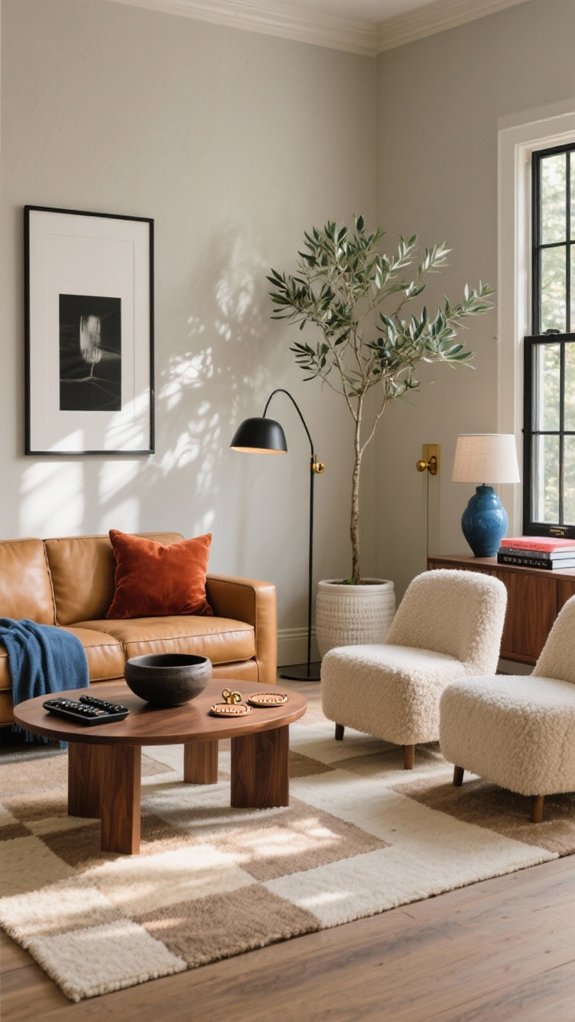
A simple, unified color palette makes every decision easier and helps the room feel intentional instead of busy.
Start by choosing your base. Pick two or three neutrals you actually like living with, not just what looks good on a screen.
Warmer neutrals (think creamy white, oatmeal, warm taupe) make a room feel cozy because they soften shadows and pair well with wood tones.
Cooler neutrals (crisp white, light gray, greige) read cleaner and airier, which can make small rooms feel larger.
If you’re painting, test a few proven shades on the wall: Benjamin Moore White Dove (warm white), Sherwin-Williams Alabaster (soft warm white), or Farrow & Ball School House White (gentle neutral).
For upholstery and rugs, look at natural textures like flax linen, wool, or flatweave cotton to keep the base calm and forgiving.
Once the base feels solid, add one or two accent colors.
Limiting the palette makes shopping faster because you can ignore everything that doesn’t fit.
Navy, olive, rust, and blush are easy to live with and mix well with both warm and cool bases.
Use them where you can switch them out without a headache: pillows, throws, lampshades, artwork, and a patterned rug.
For example, pair a warm white room with olive and rust—olive linen pillow covers from H&M Home, a rust cotton throw from Target’s Threshold line, and a Loloi II Layla rug in Olive/Charcoal.
Prefer cool? Try navy and slate: West Elm cotton-velvet navy pillows, a slate-blue linen throw from Quince, and a simple navy-striped curtain panel from IKEA RITVA.
Balance light, mid, and dark tones so the room doesn’t float or feel heavy.
A good starting ratio is 70% base, 20% accent, 10% dark.
That means most large surfaces (walls, big sofa, large rug) sit in the base palette.
Your accents show up on textiles and art.
Reserve the darkest tones—black, charcoal, deep espresso—for small but deliberate moments: a matte black floor lamp, slim black metal frames, a charcoal side table, or a dark stripe in a rug.
That 10% gives the eye a place to land and makes lighter colors look brighter by contrast.
Test everything before you commit.
Colors shift with light, and light changes throughout the day.
Get peel-and-stick paint samples from Samplize, place them on multiple walls, and check them at 8 a.m., 2 p.m., and after sunset.
Do the same with fabric swatches for curtains and sofas.
If your lighting runs cool and harsh, swap bulbs to 2700K–3000K; this small change often fixes “why does this gray look purple?” problems.
When adjusting, change one item at a time so you can see exactly what helped or hurt.
Pay attention to saturation, not just hue.
If the room feels loud, keep your accent color but slide to a softer version—navy to slate, emerald to olive, fuchsia to dusty rose.
If it feels flat, add texture rather than more color: a nubby boucle pillow, a woven grass tray, or a slub-linen curtain can add depth without breaking the palette.
Use plants as a steady “neutral.”
Most greens read like a background color because our eyes expect them.
A fiddle-leaf fig, olive tree, or trailing pothos adds life and works with nearly any scheme.
Keep pots simple—unglazed terracotta, matte white, or black—to stay within your palette.
A quick example to pull it together:
- Base: Walls in Benjamin Moore White Dove, natural jute rug, oatmeal linen curtains (Quince).
- Accents: Olive and rust via H&M linen pillow covers, Target rust throw, and a Loloi Layla Olive/Charcoal rug layered over the jute.
- Dark hits: CB2 matte black floor lamp, thin black IKEA frames with white mats, charcoal ceramic vase.
With a clear base, a couple of repeating accents, and a touch of dark for contrast, your living room will feel cohesive—and you’ll spend less time second-guessing every purchase.
Select and Scale Furniture to Anchor the Room
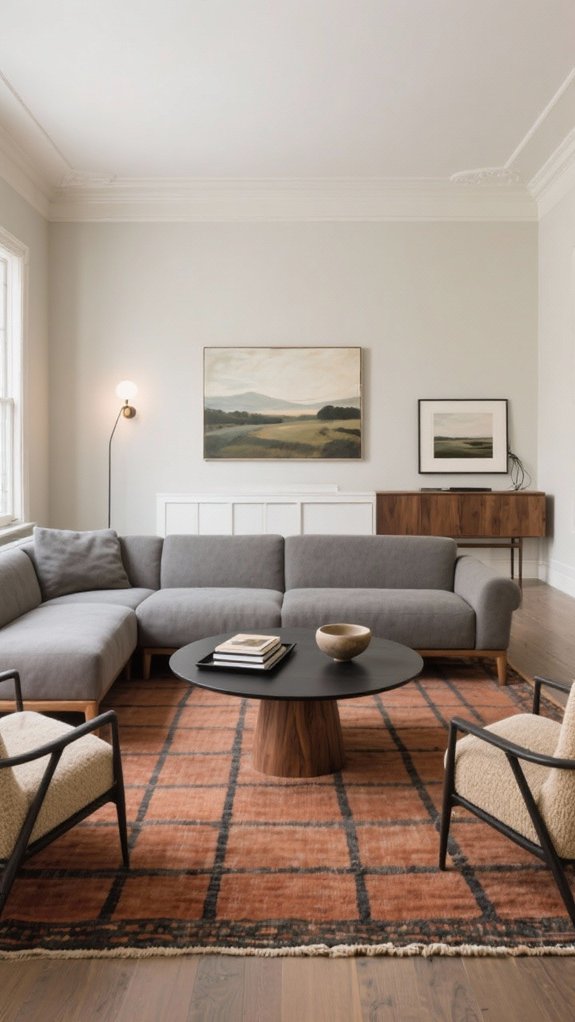
Select and scale furniture to anchor the room
Start with the anchor piece
Pick the largest seating piece your room can comfortably handle—usually a sofa or a sectional—because it sets the layout for everything else.
A good rule of thumb: aim for a sofa that’s about two-thirds the length of the wall it sits on. That keeps the piece visually grounded without swallowing the space.
For example, on a 12-foot wall, an 84-inch sofa fits nicely and still leaves breathing room for side tables and lamps. If you like to lounge, a compact sectional can sometimes work better than an oversized sofa because the L-shape creates a natural focal point and defines zones.
Options to consider: Article’s Sven Sofa (86″) for classic lines, Burrow’s Nomad Sectional for tight doorways (it ships in modules), or West Elm’s Harmony for deeper seats.
Get the proportions right
Rug size changes how the whole room feels. When the rug is too small, the seating floats and the room looks choppy.
Choose a rug large enough that the front legs of your sofa and chairs sit on it, and leave 8–12 inches of bare floor between the rug and the walls so the room doesn’t feel cramped.
In a 12×15-foot living room, a 9×12 rug often hits the sweet spot. If you want low-maintenance, look at washable options like Ruggable or Revival’s Re-Jute, which hold up well under everyday wear.
Match your coffee table to the sofa so it’s easy to use and looks balanced. Aim for a length that’s about half to two-thirds of the sofa’s length and a height that’s level with, or just an inch lower than, the seat cushions—so you can set down a drink without reaching up or down.
For an 84-inch sofa, a 42–54-inch table works well, with 16–18 inches of clearance between the table and the sofa edge for legroom.
A few solid picks: CB2’s Peekaboo acrylic table (visually light, great for small rooms), Article’s Lenia wood table (warm and sturdy), or IKEA’s Stockholm walnut veneer for value.
Side tables should serve the seat next to them. Keep the tabletop within about two inches of the sofa arm height so you don’t have to tip your glass to set it down.
If your sofa arm is 24 inches high, look for 22–26-inch-tall tables.
Small but reliable options: West Elm’s Martini side table (compact, powder-coated metal), HAY’s Slit Table (geometrics with a smaller footprint), or IKEA’s Gladom tray table for a budget-friendly moveable surface.
Plan the practical stuff before you buy
Measure how the furniture will actually get into your home. That means the width and height of doors, the tightest turn on your stairs, and your elevator’s interior dimensions.
Compare those measurements to the item’s packaged size on the retailer’s product page—not just the assembled dimensions.
For tight entries, choose sofas with removable legs or modular pieces that ship in boxes under 30 inches wide (Burrow, Floyd, and some Apt2B models do this well).
If you live in a building, book your elevator and loading dock ahead of delivery to avoid rescheduling fees.
Make assembly and setup easy
Unbox in the room where the furniture will live so you’re not wrestling big pieces through doorways. Protect floors with a blanket or flattened cardboard.
Assemble frames loosely at first, square them up, then tighten all hardware—this keeps the piece from wobbling later.
Level the feet so doors and drawers sit right, and add felt pads to protect floors and help with sliding.
Keep the spare screws and the hex key in a labeled zip bag taped to the underside of the piece for future tightening.
If you’re building shelving or media units, use the included anti-tip hardware—especially in homes with kids or pets.
A quick example
Say you have a 12×15-foot living room with a 12-foot main wall. An 84-inch sofa like the Article Sven anchors that wall.
Layer a 9×12 rug so the sofa’s front legs and the chairs opposite sit on it.
Add a 48-inch coffee table (about 17 inches high) centered on the sofa with 16–18 inches of clearance.
Flank the sofa with 24-inch-high side tables to match a 23–25-inch sofa arm.
This setup feels connected, functions well, and looks intentional without crowding the room.
Optimize Layout, Flow, and Mix of Styles
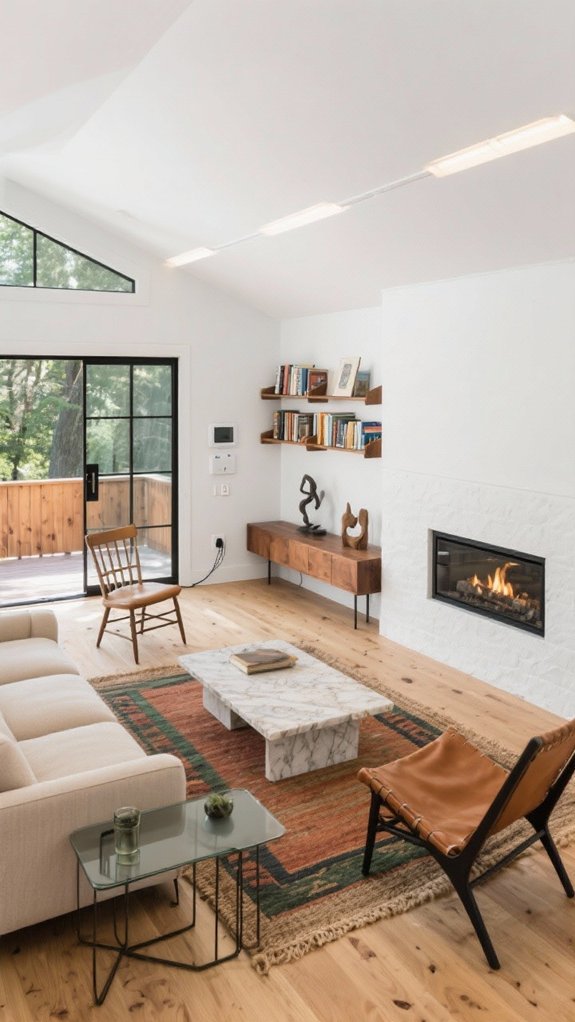
With your anchor pieces set, map the room so it’s easy to move through and easy to use. Start with clear paths: leave 36–48 inches for main walkways so two people can pass without sidestepping and doors can swing fully. Keep about 18 inches between seating and a coffee table; that’s close enough to set down a glass without leaning, but far enough not to clip your shins. If a corner feels tight, don’t be afraid to float the sofa 8–12 inches off the wall or angle a chair to open the bottleneck.
Example: in a 12-by-16-foot living room with an 84-inch sofa, a 48–54-inch coffee table keeps that 18-inch reach, and a 40-inch path to the hallway keeps traffic smooth. Nesting side tables or a slim C-table (like West Elm’s Streamline C-Table) add surface space without crowding.
Create zones so the room supports how you actually live. Aim seats toward each other first and the TV second—people read each other’s faces better when they’re not all staring straight ahead. A pair of swivel chairs (Blu Dot’s Field Swivel is a good-looking option) lets you pivot between conversation and screen time.
Define edges with a console table 12–14 inches deep behind the sofa; it quietly marks the entry and catches keys. Bookcases or a low cabinet can frame a corner reading zone without building a wall—IKEA’s Billy with doors keeps visual noise down. Use rugs to anchor each area: in most living rooms, an 8×10 works if all front legs sit on the rug; go 9×12 if you have a larger seating group to avoid the “floating island” look.
Mix styles with intention so the room feels collected, not chaotic. A simple 70/30 guide helps: let about 70% of the big pieces follow one vibe (say, clean-lined modern), then layer 30% from another (a vintage rug and a wood sideboard) for character.
Repeat elements to tie it together—choose one or two metals and show them more than once (a brass floor lamp, brass picture frames, brass cabinet knobs) and keep to two wood tones so the eye doesn’t ping-pong. Balance visual weight: a chunky sofa pairs well with an open-base coffee table (CB2’s Peekaboo acrylic or a slim black metal frame), while a delicate sofa can handle a heavier stone table (Article’s Mara marble is a sturdy option). Repeating shapes helps too—if your coffee table is round, echo that curve in a mirror or side table.
Fine-tune the details once the big pieces land. Check sightlines from each seat: can you see the fireplace, a window, or the TV without craning?
Hang art so the center sits around 57–60 inches from the floor; that keeps it in the natural viewing band. Layer your lighting so tasks feel easy and evenings feel calm—overhead light for general glow, a floor or table lamp where you read, and an accent light to warm a dark corner. Put lights on dimmers to flex for movie nights and mornings (Lutron Caséta plug-in dimmers are simple to add).
Use material shifts to cue function: stone or tile under an entry bench, a flatweave indoor–outdoor rug by the patio door, a wool rug in the main seating area. Tuck cords into paintable cable raceways and use felt pads so adjusting a piece by an inch doesn’t scar the floor. Then test the paths with a tray in hand. If you bump something or have to sidestep, slide the nearest piece two inches and try again. Small tweaks make daily use feel effortless.
Layer Textiles for Texture, Warmth, and Depth
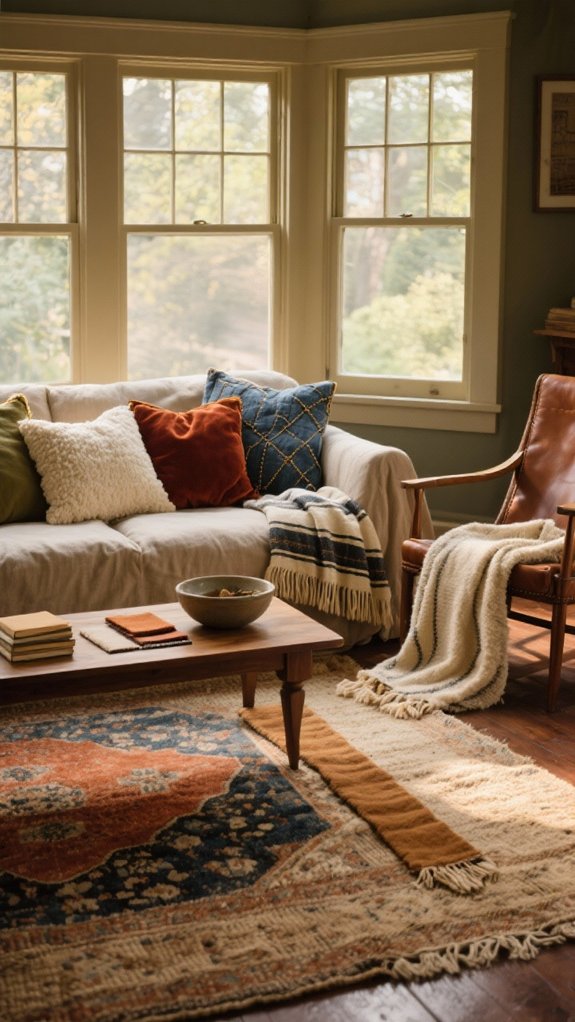
Layering textiles is the quickest way to make a living room feel finished and comfortable. Fabrics soften hard surfaces, quiet echoes, and add color and pattern without committing to major changes. When you combine a few smart pieces—a good rug, varied pillows, and a couple of throws—you get texture and warmth that you can adjust with the season.
Start with the foundation: the rug. It anchors the seating area and sets the tone for the rest of the textiles.
In high-traffic spaces or homes with kids and pets, a low-pile, tightly woven rug holds up better and is easier to vacuum. Try a flatweave wool like the Loloi “Jules” (durable and patterned enough to hide crumbs) or a washable option from Ruggable if spills are common.
If your room needs softness underfoot—think reading corners or a loungey TV area—a plush rug adds comfort and absorbs sound. A medium- to high-pile rug like the Safavieh Hudson Shag or a dense tufted wool from West Elm works well; just keep a solid vacuum routine since longer fibers trap dust.
Build comfort and shape with pillows. Scale matters: 22-inch pillows fill sofa corners and make the seating feel generous; 20-inch pillows layer in front without crowding; a lumbar (12×20 or 12×24) supports the lower back and breaks up the square shapes.
Mix textures so the eye has something to land on—pair a smooth cotton or linen with a nubby bouclé and one velvet for sheen. For inserts, down or a down-alternative with a higher fill weight keeps pillows from collapsing.
Budget-friendly covers from H&M Home or IKEA blend well with a splurge piece from CB2 or Citizenry. For example: two 22-inch linen pillows in a muted olive, one 20-inch cream bouclé, and a 12×20 rust velvet lumbar will feel collected without being matchy.
Add throws where hands naturally reach. A neatly folded throw at the back of the sofa keeps lines clean; a looser drape over an arm softens the silhouette and signals “use me.”
Stow an extra in a basket near the seating so you don’t have to get up during a movie. Choose weights by season: a lightweight linen or cotton throw like Parachute’s Cotton Knit is perfect for spring and summer; a dense wool or alpaca blend—try Barefoot Dreams CozyChic or a Pendleton wool—adds real warmth in winter.
Pick fibers for how you live, not just how they look. Linen breathes and gets softer with every wash, so it’s great for year-round pillow covers in warmer climates.
Wool insulates and resists odors, which helps if you keep windows open or run the heat often. Cotton is easy to clean and usually the most affordable, which makes it a good choice for families.
If you’re worried about stains, performance fabrics like Crypton, Sunbrella, or brushed polyester blends resist spills and clean up quickly—handy for dining nooks or light-colored sofas. Pet owners often like tight-weave cotton or performance velvet because claws don’t catch as easily as they do on chunky knits.
Care matters because textiles look their best when you maintain them a little at a time. Spot-clean weekly so stains don’t set; keep a gentle fabric cleaner and a white cloth nearby.
Rotate and fluff cushions every two weeks to even out wear and keep loft. Vacuum rugs on low suction (beater bar off for wool and high-pile) and give smaller rugs a good shake outside.
Wash removable covers inside out on cold, gentle cycle; air-dry flat to prevent shrinkage and preserve color. If you prefer little maintenance, choose washable rugs and zip-off pillow covers so cleanup is simple.
Tie everything together by repeating two colors across the room. For example, pull the olive from the rug into a linen pillow and a stripe on a throw, and echo a warm rust in the lumbar and a small tray on the coffee table.
Repeating those shades in three places each creates cohesion without feeling staged.
Starter shopping list:
- Rug: Ruggable Kamran (washable, low-pile) or West Elm Andes Tufted Wool (plush)
- Pillows: H&M Home linen 22″, CB2 velvet lumbar, Target bouclé 20″
- Throws: Parachute Cotton Knit (lightweight), Pendleton Yakima (wool)
- Inserts: Ikea FJÄDRAR (down) or Amazon Basics down-alternative, firm fill
With a solid rug, a smart mix of pillow sizes and textures, and a couple of throws placed where you’ll actually use them, your living room will feel warmer, quieter, and more inviting—without a full redesign.
Elevate the Atmosphere With Layered Lighting
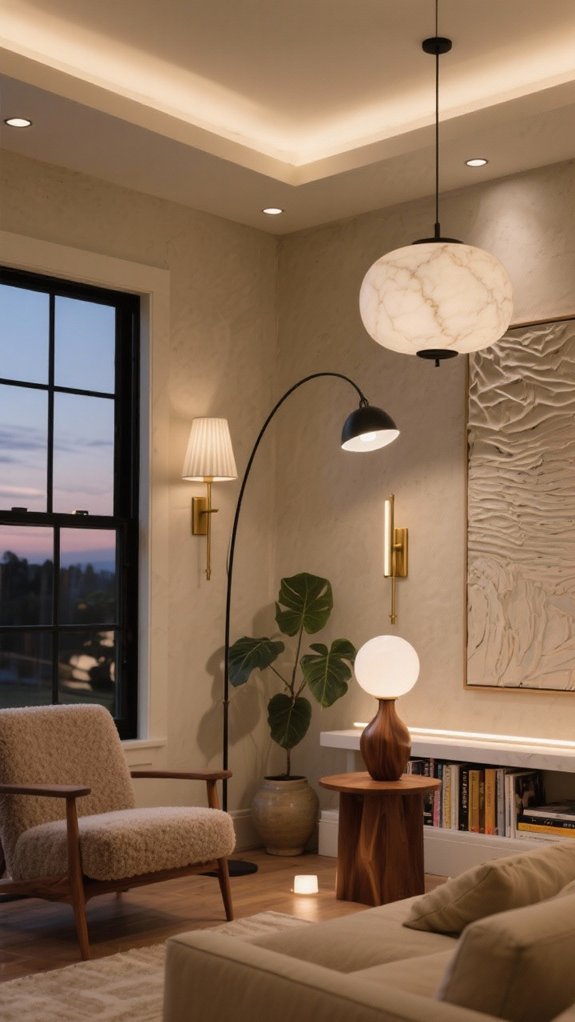
Once your furniture is in place, plan the light the same way you planned the seating—by purpose. Layering ambient, task, and accent light keeps the room from looking flat and helps your eyes adjust comfortably throughout the day. You’ll also get flexibility: bright and even for cleaning or projects, focused for reading, and softer for winding down.
Start with ambient light, which sets the base level in the room. A ceiling fixture or a pair of low-profile flush mounts spreads light evenly so corners don’t feel gloomy. For a typical 12-by-15-foot living room, aim for roughly 1,800–3,000 lumens total from your ambient sources.
Use 2700K bulbs at night because warmer light cues your brain to relax; tunable bulbs let you nudge up to 3000–3500K during the day for a crisper look. Good options: Philips Hue White Ambiance A19 bulbs (tunable), or high-CRI 2700K bulbs from Cree or Philips for accurate color. Put the ambient lights on a dimmer (Lutron Caséta is reliable and works with most fixtures) so you can slide from “bright and practical” to “low and calm” without swapping bulbs.
Next, add task lighting where people actually do things. Place a floor lamp next to the sofa and a table lamp beside reading chairs so the light falls slightly in front of and beside your shoulders—not behind your head—reducing glare on pages and screens.
Look for shades that direct light downward and bulbs around 800–1100 lumens (60–75W equivalent) with a 90+ CRI for clearer text and truer colors. Examples: the IKEA Ranarp floor/reading lamp (aimable head), the Brightech Leaf if you prefer a slim, focused uplight/downlight combo, or a simple ceramic table lamp from Target’s Threshold line paired with a 2700K bulb.
Finish with accent light to add depth and draw attention to texture. Wall sconces, picture lights, and LED strips can graze a brick wall, highlight art, or brighten a dark corner without adding glare. Plug-in sconces (Globe Electric makes affordable ones) avoid hardwiring.
For flexible strips, try Philips Hue Lightstrip Plus or Govee M1; tuck them on top of a bookshelf, under a floating shelf, or behind the TV for bias lighting (which reduces eye strain during movies). If you have plants or a sculpture, a small uplight like the Simple Designs mini can create a subtle spotlight.
Tie it all together with simple controls. Create a few scenes you’ll actually use:
- “Chores” at ~80–100% on ambient, task lights on, accent off.
- “Company” around 50–60% ambient with warm accent lights on.
- “Movie” at 20–30% ambient, task lamps off, TV bias light set to a cool neutral (around 6500K) to ease contrast.
You can build these with Hue, Caséta + Pico remotes, or a smart plug for lamps if you don’t want a full system. The result is a room that supports whatever you’re doing and feels good on your eyes at every hour.
Style Walls, Focal Points, and Accessories With Intention
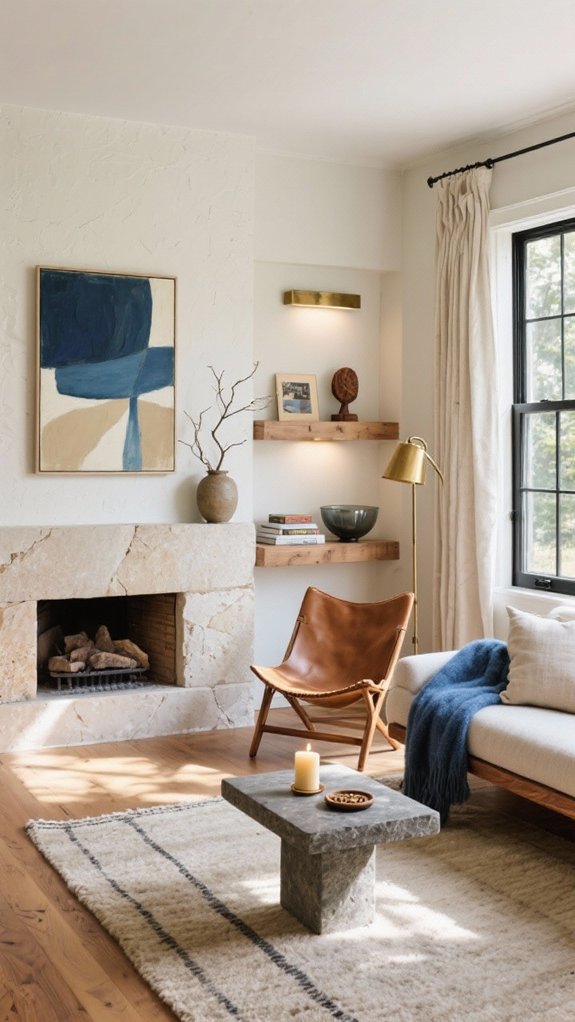
With your layout and lighting in place, the next step is to shape what people notice first and how the room feels over time. Walls, focal points, and accessories do more than “fill space”—they direct attention, balance visual weight, and make the room feel intentional.
Walls
Treat your walls like you’d the outfit’s jacket: they pull everything together and set the tone. If you’re building a gallery, pick a clear theme—travel photos in black and white, botanical prints, or family portraits—so the collection reads as one idea instead of visual noise. Matching or closely related frames help; thin black metal or warm oak frames are versatile.
Hang the center of each piece around 57 inches from the floor (roughly eye level) so art feels connected to the room, not floating too high. Picture ledges (like IKEA Mosslanda) make swapping pieces easy without new holes, and Command picture strips keep rental walls intact.
Mirrors matter because they multiply light and extend sightlines. Place one across from a window to brighten the room and make it feel larger. A round option softens sharp angles—try the Umbra Hub 37″ or the Project 62 Round Metal Mirror from Target.
If your space lacks character, choose one feature wall to anchor the room. Paint offers the biggest impact for the least effort: deep charcoal (Farrow & Ball Railings) adds contrast in modern rooms, while warm white (Benjamin Moore Swiss Coffee) calms busy spaces. Wood slat panels add texture and warmth; look at prefinished oak slats from The Wood Veneer Hub. For renters, peel-and-stick wallpaper from Chasing Paper or Tempaper creates pattern without commitment. Limiting the treatment to one wall keeps the room grounded without overwhelming it.
Focal points
Every room needs one clear “start here” moment. If you have a fireplace or TV wall, make that the focal point and support it with symmetry and light. Flank the area with slim plug-in sconces (West Elm Sculptural Plug-In Sconce or IKEA Ranarp) to frame the view and add evening glow.
Houseplants soften hard lines—tall options like a fiddle-leaf fig or olive tree in a 12–14″ planter work well; a lightweight ceramic pot from H&M Home or a simple fiberstone planter from West Elm keeps it clean. On the mantel, use odd-numbered groupings because they create a more relaxed, natural balance. Try a large 24×36 art print leaning against the wall, a medium vase with leafy branches, and a small sculptural object or candle.
If you don’t have a fireplace, create a focal point with oversized art (one piece at least 30–40 inches wide), a large mirror, or a Samsung Frame TV that doubles as art. A low, long console under the TV visually grounds the wall; add two baskets beneath for texture and hidden storage.
Accessories
Accessories should serve a job: corral, soften, or spark interest. Grouping items on a tray keeps pieces from looking scattered and makes cleaning easier. On a coffee table, layer a 12–16″ tray (CB2’s marble or H&M Home’s rattan), two stacked books (Tom Ford or Architectural Digest at 100), and a candle (P.F. Candle Co. Teakwood & Tobacco or Byredo Bibliothèque).
Vary height and materials—ceramic next to glass, matte with gloss—so the arrangement has rhythm. This variety matters because your eye reads differences as depth, which makes a small collection feel richer. Leave negative space on surfaces so your eye can rest; a clear third of the tabletop usually feels right.
Plan soft layers that are easy to refresh: 20×20 pillow covers with 22×22 down-alternative inserts keep sofas looking full without being stiff (check Amazon Basics inserts and linen covers from MagicLinen or H&M Home). Add one living element—even a low-maintenance ZZ plant or pothos—to bring movement and color; a simple terracotta or matte ceramic planter works in most styles. Edit once a week: put stray items back, rotate stems, and move one piece to a new spot. Small, regular tweaks keep the room feeling alive without buying more.
Quick picks to make it easy
- Frames: IKEA Lomviken (aluminum), Target Threshold wood frames
- Mirrors: Umbra Hub 37″, Project 62 Round Metal Mirror
- Peel-and-stick wallpaper: Chasing Paper “Saint Arboretum,” Tempaper “Travertine”
- Sconces: West Elm Sculptural Plug-In, IKEA Ranarp plug-in
- Plants: ZZ plant, olive tree (try Bloomscape or local nursery)
- Trays and decor: CB2 marble tray, H&M Home rattan tray, P.F. Candle Co. candles
- Pillow inserts: 22×22 down-alternative (Amazon Basics)
When you choose each piece with a reason—more light here, a calm landing spot there—the room starts guiding you where to look and how to feel, which is the real work of good design.
Frequently Asked Questions
How Much Should I Budget and Prioritize Spending for Living Room Updates?
Here’s a simple way to budget for living room updates that puts money where it actually improves daily life.
Put most of your budget—about 60–70%—into seating and rugs. These pieces do the heavy lifting: your sofa, chairs, and rug shape comfort, durability, and the overall look. A quality sofa keeps its shape, resists stains, and feels good to sit on every day. The rug anchors the room, softens sound, and visually ties everything together. For example, pair a performance-fabric sofa (look at Article, West Elm Performance, Interior Define, or IKEA’s FARLOV with a custom slipcover) with a hard-wearing rug (Ruggable for easy washing, or a wool rug from Loloi or Revival for a thicker, long-lasting feel). Don’t forget a good rug pad; it protects the rug and keeps it from sliding.
Spend 15–20% on lighting because one overhead light won’t flatter anyone or anything. Layered lighting—floor lamps, table lamps, and dimmable bulbs—lets you switch from bright task light to cozy evening light in seconds. Try a tall arc floor lamp over the sofa (CB2 or Brightech), a pair of table lamps on side tables (Target’s Threshold line is solid value), and dimmable LED bulbs (Philips Hue or Feit Electric). Aim for warm white (2700–3000K) in living spaces.
Set aside 10–15% for art and textiles. These are the pieces that make the room feel personal and finished. Framed prints from Etsy or Minted, a large canvas, or a gallery wall can fill big empty walls for less than custom art. Textiles—throw pillows, blankets, curtains—add color, pattern, and texture without a big commitment. Mix a couple of higher-quality pillow inserts (down or down-alternative) with washable covers from H&M Home, CB2, or Society6.
Keep 5–10% for accessories. Trays, coffee table books, a big planter with a real or faux tree, and a few sculptural objects bring the room to life and help with function. A lidded box hides remotes; coasters save your table; a wireless charging pad keeps cords in check. Think fewer, larger pieces rather than lots of small clutter.
Budget tiers to help you plan:
- Basic: Stick to clean lines and durable basics. Example: IKEA or Costco sofa with a performance cover, an 8×10 Ruggable rug, Brightech floor lamp, Target table lamps, framed Etsy prints, and H&M Home textiles.
- Upgrade: Step up materials and comfort. Example: Article or West Elm performance-fabric sofa, a wool Loloi or Revival rug, CB2 or Schoolhouse lamps, Minted art in custom frames (Framebridge), linen curtains, and down pillow inserts.
- Splurge: Invest for the long haul. Example: Bench-made sofa (Interior Define, Maiden Home), hand-knotted wool rug, Schoolhouse or Roll & Hill lighting, limited-edition or original art, custom drapery, and solid-wood accent tables.
If you want ballpark numbers, here’s how those percentages can look:
- On a $2,000 budget: $1,200–$1,400 seating/rug, $300 lighting, $200 art/textiles, $100–$200 accessories.
- On a $5,000 budget: $3,000–$3,500 seating/rug, $750 lighting, $500–$750 art/textiles, $250–$500 accessories.
- On a $12,000 budget: $7,200–$8,400 seating/rug, $1,800–$2,400 lighting, $1,200–$1,800 art/textiles, $600–$1,200 accessories.
Quick tips to stretch value:
- Choose a performance or removable slipcover sofa if you have kids or pets.
- Size up your rug: aim for at least the front legs of sofas/chairs on the rug; 8×10 is a common minimum.
- Add dimmers or smart plugs so you can set scenes without rewiring.
- Repeat colors or materials (e.g., black metal in lamp and side table) to make the room feel intentional.
This approach keeps comfort and daily use at the top of the budget, then layers in light, personality, and finishing touches for a room that feels good and works hard.
What Materials Are Most Durable for Pets and Kids Without Sacrificing Style?
When pets and kids are part of daily life, materials have to work harder. The goal is to choose finishes that resist stains, claws, and rough-and-tumble play without looking like “kid-proof” gear.
For upholstery, look for performance fabrics that are solution-dyed and tightly woven. Solution-dyed acrylic and polyester don’t just have color on the surface—the pigment runs through the fiber—so stains and sun fade are less of a problem. Tight weaves also leave fewer loops for claws to catch. Good options include Sunbrella and Perennials (solution-dyed acrylic) and Crypton-treated polyester or cotton blends, which block spills before they soak in. If you like the look of velvet, try performance polyester velvet from brands like InsideOut or Revolution; it resists crushing and cleans up with soap and water. Skip loose, loopy textures like bouclé if you have a cat that kneads or a dog that digs.
Leather can be a great choice when you pick the right type. Go for top-grain, semi-aniline leather—it has a light protective finish, so it resists stains and wipes clean, but still looks natural. Full-aniline feels wonderful but marks easily, which can read as “patina” or “pen disaster,” depending on your house. Sofas from Article, West Elm, or Room & Board often list leather type, so you can choose knowingly. Keep a leather cleaner like Leather CPR on hand for quick touch-ups.
Flooring takes a beating, so durability and maintenance matter. Luxury vinyl plank (LVP) is tough, waterproof, and quiet underfoot—helpful with zoomies and dropped toys. Look for 20-mil wear layers and click-lock systems from Coretec or Shaw Floorte. If you want real wood, choose a harder species (white oak, hickory) with a matte polyurethane or aluminum-oxide finish; the low sheen hides scratches better than glossy coats. Porcelain tile is nearly bulletproof for entries, kitchens, and mudrooms—pair it with a darker epoxy grout so spills and paw prints don’t stain.
Covers and rugs make cleanup faster. Washable slipcovers let you toss the mess in the machine instead of spot-cleaning for hours. Pottery Barn Performance Slipcovers, 7th Avenue’s machine-washable covers, or custom options from Bemz/Comfort Works for IKEA frames are easy to live with. For rugs, indoor–outdoor polypropylene or PET blends handle spills and rough play; Dash & Albert and West Elm performance rugs hose off or clean with a mild solution. If you want patterns that hide crumbs and paw prints, try Ruggable’s machine-washable rugs for high-traffic rooms.
A few small details go a long way: choose sofas with removable, reversible cushion covers; pick medium tones and subtle patterns to disguise wear; and add felt pads under furniture to protect floors from enthusiastic slides. These choices don’t just survive family life—they keep your home looking pulled together without constant fussing.
How Can I Make Eco-Friendly, Sustainable Decor Choices and Furnishings?
Start with materials that last and come from responsible sources. Vintage and secondhand pieces keep existing furniture in use and out of landfills, and older solid-wood items are often easier to repair than new particleboard. If you buy new, look for FSC-certified wood, which means the Forest Stewardship Council tracked it from a responsibly managed forest. Brands like Emeco (recycled aluminum chairs), Vitsoe (606 shelving you can add to for decades), and Sabai (sofas with recycled fabrics and replaceable parts) build for longevity. Natural fibers—wool, linen, hemp, jute—breathe better, age well, and avoid shedding microplastics. For example, a wool rug from Nordic Knots or a jute runner from Dash & Albert will wear in, not wear out.
Choose finishes and fabrics that protect your indoor air. Low- or zero-VOC paints cut down on the fumes that can trigger headaches and asthma, and they keep off-gassing to a minimum long after the room “smells” dry. Look at ECOS Paints, Clare, or Sherwin-Williams Harmony. For wood care, plant-based oils like Rubio Monocoat avoid harsh solvents. When you need upholstery, consider recycled or upcycled textiles—Sabai’s recycled velvet, or slipcovers from Bemz that refresh an existing IKEA sofa instead of replacing it.
Plan for repair and upgrades so you buy less over time. Pick furniture with visible fasteners and standard hardware; it’s easier to tighten, refinish, or reupholster. Modular pieces like the Floyd bed or sofa let you replace a leg or arm instead of the whole frame. If a chair seat wears through, a local upholsterer can rebuild it; you’ll get a like-new piece without the waste. For lighting, swap to ENERGY STAR LEDs in a warm 2700K color; they cut energy use by up to 80% and last for years. Philips, Cree, and Feit make reliable bulbs, and smart plugs can automate lamps without replacing fixtures.
Support local makers when you can. Buying from nearby woodworkers, potters, and textile artists reduces shipping emissions and keeps money in your community. Check neighborhood markets, Etsy filters for “local,” or shops like West Elm Local that highlight nearby artisans. When you’re done with something, donate or sell it—Habitat for Humanity ReStore, Craigslist, or Facebook Marketplace—so it stays in circulation. Avoid “fast furniture” built from low-grade composites and glued-on veneers; it often breaks sooner, contains more adhesives, and heads to the dump quickly. A slower approach—buy fewer, better pieces, repair them, and be picky about materials—shrinks your footprint and gives your home more character over time.
What’s the Best Way to Plan Timelines and Manage Deliveries/Returns?
Start with a delivery calendar that includes real lead times and a buffer. Vendors quote “8–10 weeks” for items like custom sofas; plan for 10 and add a 2-week cushion. That extra time protects the install date if a fabric is backordered or a truck gets delayed. Use a simple Gantt-style view so you can see when each item ships, when it should arrive at the receiver or site, and when you plan to install. Tools that work well: Google Calendar for shared milestones, Airtable or Trello for item-by-item tracking, and a weekly reminder to reconcile tracking numbers.
Confirm site access before you book anything. Measure doorways, stairwells, and elevators (width, height, turning radius), and note any tight corners. A 36-inch-wide console might still fail if the elevator door opening is 33 inches. Ask the building if they require a Certificate of Insurance (COI) and whether deliveries must happen during a service window. If you have a heavy or delicate item (marble dining table, lacquered credenza), book white-glove delivery to protect the piece and your walls. If it’s boxed casegoods, “room of choice” may be fine; for upholstery and assembled pieces, white-glove saves time and reduces damage.
Track every order in one place. Include vendor, PO number, finish/fabric, promised ship date, carrier, tracking link, and return window. Tag each item by room so you can stage installations by space rather than by vendor. Example fields that help: “Unboxed/Inspected (Y/N),” “Photos Saved (link),” and “Packaging Stored (location).”
Unbox and inspect as soon as items arrive—ideally within 24 hours and always within the vendor’s damage-report window (often 48–72 hours). This matters because most vendors deny claims after that period, even for concealed damage. Photograph all sides of the box before opening, the packaging inside, the product from multiple angles, and any labels. Take close-ups of defects with a ruler for scale. Apps like Google Photos or Notion make it easy to store photos and link them to the order record.
Keep the packaging until you’re sure you won’t return the item. Many vendors require original cartons for RMAs, and repacking without them can void claims or add restocking fees. Break down boxes neatly, keep hardware bags, corner protectors, and pallet straps together, and label bundles with painter’s tape and a Sharpie. A few sturdy shelving units (e.g., 48-inch Metro wire racks) or a small storage unit will save you headaches during a multi-room project.
Follow each vendor’s return protocol to the letter. Check the deadline to request an RMA, restocking fees (10–35% is common), and whether they cover return freight. Email support with your PO, photos, and a concise defect description (“Left arm seam 2″ open at front panel; see Photos 3–5”). Ask for a prepaid label or pick-up and confirm repackaging requirements. For high-value items, request a pick-up window in writing and note whether you need a liftgate.
Stage installations and avoid overlapping deliveries. Schedule trades and deliveries in logical order: paint and electrical first, large rugs and assembled casegoods next, then upholstery, art, and accessories. Don’t send the sofa on the same day the electrician opens walls; you’ll invite damage and delays. For whole-home installs, stagger rooms over two or three days so the crew can focus, clean as they go, and correct issues without a traffic jam.
A few practical add-ons:
- Delivery tools: a basic toolkit (drill/driver, furniture sliders, stud finder), moving blankets, and felt pads (e.g., X-Protector pads) to protect floors.
- Labels: QR code stickers (Avery) that link to your Airtable record for quick lookups on site.
- Receivers: If you can’t accept freight, use a reputable receiving warehouse that photographs arrivals and reports damage same day. Ask about their inspection process and storage fees.
How Do I Improve Acoustics and Reduce Echo in an Open Living Room?
Start with the big, soft surfaces. Hard floors bounce sound, so lay down a dense wool rug with a quality felt rug pad to stop the echo at the source. A thick 8×10 in the main seating area often does more than two smaller rugs. Floor-to-ceiling curtains also help because their mass and pleats absorb mid and high frequencies that make rooms sound harsh. Look for lined or blackout drapes in velvet or heavy twill; double-rod setups let you layer a sheer with a heavier panel for added absorption. Choose upholstered seating over slick leather—fabric and cushions soak up sound that would otherwise ping around the room.
Treat the main reflection points next. These are the spots where sound from voices or a TV first bounces off walls and the ceiling before reaching your ears. Find them with the mirror trick: sit in your usual seat and have someone move a mirror along the wall; wherever you can see the speaker in the mirror, that’s a reflection point. Mount 2–4 inch thick broadband acoustic panels there to reduce slap echo and improve clarity. Brands like GIK Acoustics, ATS Acoustics, and Acoustimac offer panels in fabrics that look like decor, not studio gear. In corners, add bass traps (thicker, often triangular panels) to tame low-frequency bloom in open rooms.
Don’t forget the ceiling, especially in tall spaces. A ceiling cloud above the conversation area shortens the sound path and stops flutter echo between floor and ceiling. You can hang a ready-made cloud (GIK 242 or Acoustimac DMD) with simple eye hooks, or DIY one with 2–4 inch mineral wool (Rockwool Safe’n’Sound), a wood frame, and breathable fabric like Guilford of Maine or even cotton canvas.
Use storage and art to do double duty. Fill open shelves with books of varied sizes and a few baskets or fabric bins. The uneven surfaces scatter sound and the soft items absorb it, which keeps the room from sounding “shouty.” Large canvas art or fabric-wrapped panels work better acoustically than glass-framed prints. If you love framed art, mix in a couple of fabric pieces or a tapestry to balance the reflections.
Last, tighten up the layout. Pull seating closer together and away from bare walls so voices don’t have to carry. Add soft side pieces—throw pillows with down or poly-fill, a thick knit throw, a fabric ottoman, even a couple of large plants with dense leaves. These small absorbers reduce the number of hard, parallel surfaces that cause echo.
Quick picks:
- Rug: Dense wool with a 3/8–1/2 inch felt pad (e.g., Rugs USA wool + RugPadUSA felt).
- Curtains: Blackout velvet panels with a double rod (e.g., West Elm or IKEA Majgull).
- Panels: GIK Acoustics 244 (walls), 244 or 242 as a ceiling cloud; GIK Tri-Traps for corners.
- DIY: Rockwool Safe’n’Sound, 1×3 pine frame, breathable fabric, D-ring picture hangers.
You’ll hear the difference right away: clearer conversation, less ring on claps, and a room that feels calm instead of cavernous.